

Preparing for pregnancy isn’t just about age; it’s about your systemic hormonal health, long before conception begins. Because it takes about 90 days for an egg to fully mature, the lifestyle choices you make in the three months before trying to conceive can significantly influence egg quality, hormone balance, implantation, and fecundability (the probability or chance of pregnancy). This 90-day window gives you a powerful opportunity to optimize progesterone, insulin sensitivity, and thyroid function, all key factors in fertility.
At Vita Bella, conception begins long before the test turns positive. It starts with you, your hormones, and the choices you make today. The next 90 days are a powerful window to elevate your progesterone, balance insulin, and optimize your thyroid for a smoother conception journey. With the right science-backed habits, you can nourish your body, protect your hormones, and create the healthiest foundation for a future pregnancy. Let’s walk through the evidence-based steps that help you prepare beautifully from the inside out.
Can Chronic Stress Really Disrupt Progesterone and Impact Your Fertility?
Chronic stress affects fertility through hormonal pathways that directly influence progesterone, the hormone essential for a healthy luteal phase and successful implantation. In a large prospective cohort1 of 401 women trying to conceive, higher levels of the stress biomarker α-amylase were associated with a 29% reduction in fecundability, meaning these women were significantly less likely to conceive in a given cycle. This study shows how chronic stress can impair reproductive hormone regulation during the crucial pre-conception window.
Short-term stress affects ovulation and luteal function, and it can disrupt the regular menstrual cycle. Moreover, human data show that stress exposure can disrupt luteal phase function. According to a study2, endocrine alterations, such as luteal insufficiency, reduced ovarian reserve function, and transient stress, are mostly linked to luteal phase defect.
What Practical Steps Can You Take in the 90-Day Pre-Conception Window?
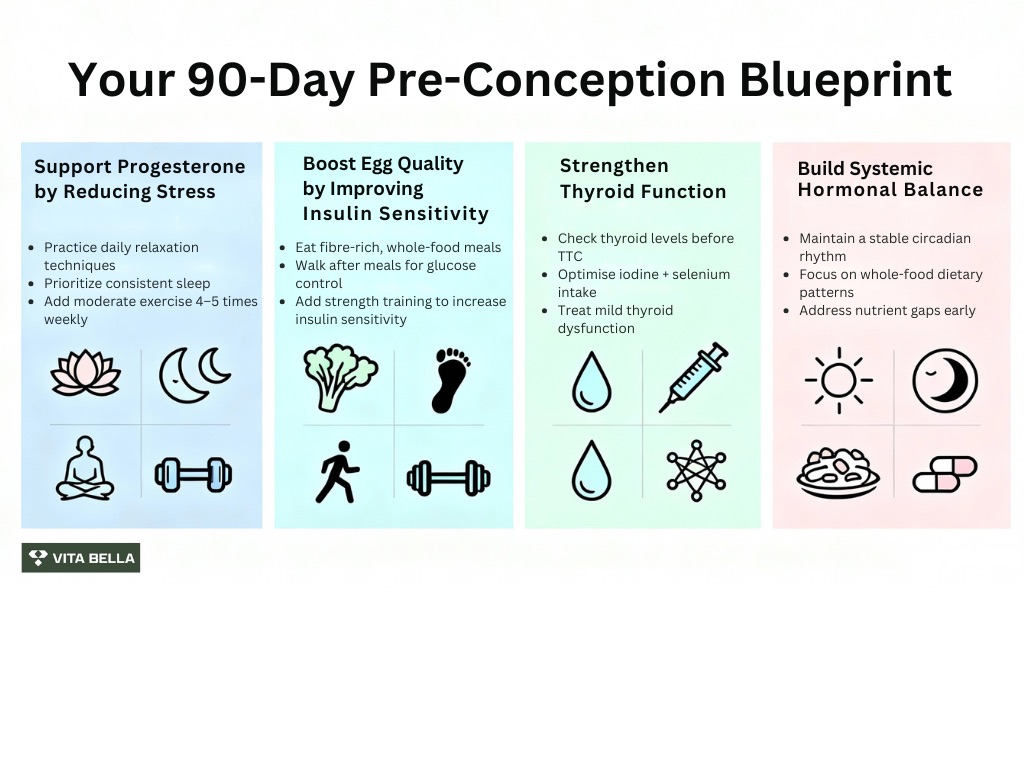
Preparing during the 90-day pre-conception window allows you to influence egg quality, hormonal balance, and overall reproductive health. By focusing on stress regulation, insulin sensitivity, thyroid optimization, and daily lifestyle habits, you create a stronger foundation for conception. Small, consistent changes during this period can make a meaningful difference in fertility outcomes. Here’s how you can start making those impactful changes right now:
Prioritize 7–9 hours of sleep for cortisol regulation.
Add moderate exercise (walking, yoga, cycling) at least 5 days per week.
Practice stress-modulating techniques such as mindfulness or breathing exercises.
By reducing chronic stress, you create a hormonal environment that naturally protects progesterone production and improves your chances of conceiving.
What Can You Do in the 90 Days Before Conception to Improve Insulin Balance?
Improving insulin balance in the 90 days before conception helps support healthier egg maturation, more stable ovulation, and better overall hormonal harmony. Prioritizing whole-food, low-glycemic meals and adding consistent movement throughout the day can significantly enhance insulin sensitivity (reducing insulin resistance). These changes help reduce inflammation and create a stronger metabolic foundation for conception.
Choose low-glycemic, fiber-rich meals.
Include movement after meals to reduce glucose spikes.
Maintain regular moderate exercise (150 minutes weekly).
Improving insulin sensitivity enhances follicle development, promotes hormonal balance, and supports higher-quality oocytes.
How Do Thyroid Hormones Influence Your Fertility?
Thyroid hormones influence nearly every aspect of fertility, from follicle maturation to ovulation to early embryo development. A large retrospective cohort5 of 1443 infertile women showed that ovarian reserve marker AMH peaked at a TSH level of ~2.88 mIU/L; AMH declined when TSH was either higher or lower, highlighting the importance of maintaining optimal thyroid balance, especially before conception.
Empower Your Fertility Journey with Vita Bella
Most women don’t realize how stress and metabolic changes disrupt the fertility timeline. Hormones quietly shape fertility long before pregnancy is even on your mind. When cortisol rises, progesterone falls, reducing your chances of implantation. Insulin resistance silently impacts the quality of each maturing egg. Thyroid imbalances slow your body’s natural reproductive rhythm.
Vita Bella helps you address the root causes with targeted, holistic pre-conception support. Our guidance enhances hormone harmony, stabilizes metabolic health, and strengthens thyroid balance. Give your fertility the care it deserves with Vita Bella as your trusted partner.
Frequently asked questions
Yes, the 90-day window aligns with the full egg maturation cycle, giving your body time to optimize progesterone levels, improve insulin sensitivity, stabilize thyroid hormones, and enhance overall systemic health. By supporting these hormonal pathways early, you create a more fertile internal environment that can increase your chances of conception and a healthier pregnancy.
Yes, chronic stress elevates cortisol, which interferes with the brain–ovary signaling required for robust luteal progesterone production. When progesterone drops, implantation becomes more difficult. Managing stress in the pre-conception phase helps restore hormonal balance, strengthens the luteal phase, and creates better conditions for natural conception and early pregnancy stability.
Yes, insulin resistance can negatively influence egg maturation and embryo quality even in women without PCOS or excess weight. When cells respond poorly to insulin, inflammation and hormonal disruption occur, affecting ovarian function. Improving insulin sensitivity during the pre-conception period helps support healthier eggs, more regular ovulation, and stronger fertility outcomes.
Yes, healthy thyroid hormone levels are essential for ovulation, embryo development, and early pregnancy support. Even mild thyroid imbalances can contribute to irregular cycles or reduced fertility. Assessing and optimizing TSH, Free T4, Free T3, and thyroid antibodies before conception ensures your reproductive system functions smoothly and supports a more successful conception journey.
References:
Lynch, C. D., Sundaram, R., Maisog, J. M., Sweeney, A. M., & Buck Louis, G. M. (2014). Preconception stress increases the risk of infertility: Results from a couple-based prospective cohort study—the LIFE Study. Human Reproduction, 29(5), 1067-1075. https://doi.org/10.1093/humrep/deu032
Shi, L., Cui, L., Yang, L., He, L., Jia, L., Bai, W., Wang, L., & Xu, W. (2024). Hotspots and frontiers in luteal phase defect research: An in-depth global trend bibliometric and visualization analysis over a 52-year period. Heliyon, 10(15), e35088. https://doi.org/10.1016/j.heliyon.2024.e35088
Wang, H., Zhang, Y., Fang, X., Kwak-Kim, J., & Wu, L. (2021). Insulin resistance adversely affect IVF outcomes in lean women without PCOS. Frontiers in Endocrinology, 12, Article 734638. https://doi.org/10.3389/fendo.2021.734638
Yan, R., Zhang, J., Ma, H., Wu, Y., & Fan, Y. (2025). Potential of seven insulin resistance indicators as biomarkers to predict infertility risk in U.S. women of reproductive age: A cross-sectional study. Reproductive Biology and Endocrinology, 23, Article 77. https://doi.org/10.1186/s12958-025-01416-w
Halici, M., Seker, M. E., Gebedek, I. Y., Gokbak, M. N., Cetisli, A. F., Ciftci, A. B., Konac, E., Yildirim Kopuk, S., Tiras, B., & Cakiroglu, Y. (2023). Thyroid hormones and ovarian reserve: A comprehensive study of women seeking infertility care. BMC Women’s Health, 23, Article 570. https://doi.org/10.1186/s12905-023-02725-1