Bioidentical hormone delivery methods include pellets, injections, and creams. Each one shapes how consistently your hormone levels hold throughout treatment. Pellets dissolve slowly over several months; injections act within hours but levels peak and then drop before the next dose; creams absorb daily through the skin, with results that vary by person. A hormone therapy provider uses your labs and symptoms to identify the right BHRT treatment option for your goals.
Bioidentical hormone delivery methods: a quick comparison
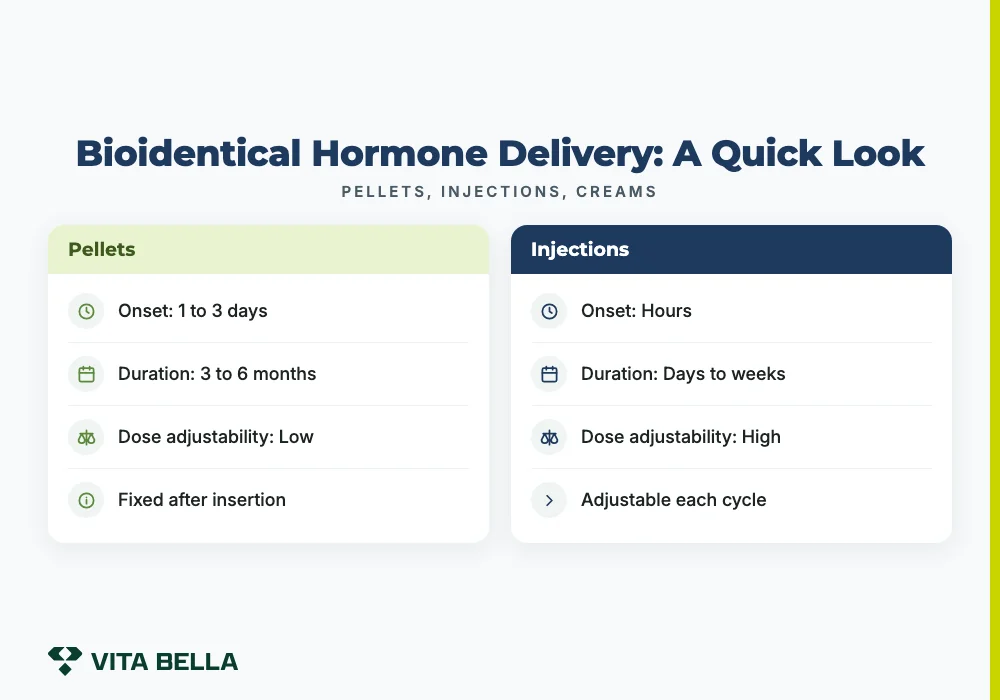
The three primary options differ in four practical ways:
| Method | Onset | Duration | Dose adjustability |
|---|---|---|---|
| Pellets | 1 to 3 days | 3 to 6 months | Low (fixed after insertion) |
| Injections | Hours | Days to weeks | High (adjustable each cycle) |
| Creams | Hours to days | Daily reapplication | Moderate (adjusted at refill) |
The right method depends on your hormone levels, your schedule, and how consistently you can follow a daily or weekly routine. A review in Translational Andrology and Urology confirmed that testosterone preparations, including pellets, injections, and topical formulations, each produce distinct absorption and clearance profiles, which directly affects how providers structure treatment plans.
Which BHRT delivery method provides the most stable hormone levels?
Hormone pellets typically offer the most stable levels of any bioidentical hormone delivery method. They dissolve at a near-constant rate, releasing hormone continuously without the peak-and-trough pattern that injections create. That steady supply matters most to people who notice changes in energy, mood, or sleep when their levels fluctuate.
Injections create predictable cycles. Levels rise in the hours after each injection, then decline until the next dose. For some people that rhythm is barely perceptible. For others, the difference between peak and trough is significant. The Journal of Clinical Endocrinology and Metabolism recommends choosing treatment based on patient preference, treatment burden, and hormone response, which is why injection timing can be adjusted at each cycle.
Hormone cream absorption introduces its own variable. Creams applied daily maintain a more frequent input than weekly injections, but the amount crossing the skin barrier depends on application site, skin moisture, and individual physiology. Consistent technique matters more than most people expect, and lab monitoring becomes especially important to confirm levels are actually reaching the target range.
How long do hormone pellets last compared to injections?
Hormone pellet longevity is one of the clearest practical advantages over injections. A single insertion typically sustains hormone levels for three to six months, depending on metabolism and physical activity. Injections require repeat dosing on a much shorter cycle. A licensed provider determines the exact schedule after reviewing your labs.
This difference reshapes daily life. Pellets mean fewer clinic visits and no weekly self-injections. Hormone pellet therapy benefits people with demanding schedules: less management, more predictability. The trade-off is commitment. Once inserted, a pellet cannot be removed or adjusted until the next cycle.
BHRT pellets vs injections often comes down to one question: do you want fewer touchpoints or more flexibility? If your hormone needs are likely to shift during treatment, injections give providers room to adapt quickly at each dosing interval.
Are hormone creams as effective as pellets for women?
Creams can be effective, but the answer depends on consistent daily use and reliable hormone cream absorption. For women tracking perimenopausal or postmenopausal symptoms, including energy, sleep, mood, and libido, variability in how much hormone crosses the skin barrier can complicate the picture. Absorption shifts with skin dryness, application site, and time of day.
Pellets remove that daily variable. For women who prefer a set-it-and-revisit-in-months approach, the steadier delivery can mean more predictable symptom control across the full treatment period. The International Journal of General Medicine notes that treatment decisions should reflect individual goals, preferences, and medical history, which means neither pellets nor creams are universally the better option.
Creams remain a practical choice for women who prefer to avoid both needles and an in-office insertion procedure. A licensed provider determines the dose after labs, then monitors absorption through follow-up testing to confirm levels are hitting the target range.
Can you combine peptide therapy with bioidentical hormone replacement?
Yes. Peptide therapy hormone balance support works through a different mechanism than BHRT, which is why combining the two can address multiple goals at once. Peptides are short chains of amino acids that signal the body to produce or regulate various compounds. They do not replace hormones directly. Instead, they support the messaging systems that govern how hormones are made and used.
Growth hormone secretagogues are one well-studied peptide class relevant to hormone health. A review in Drug Discovery Today found that these peptides stimulate natural growth hormone release and showed potential in aging, obesity, and catabolic conditions. Because they work on a different pathway than bioidentical hormone delivery methods, peptides can complement BHRT rather than overlap with it.
Some providers combine both approaches for patients focused on recovery, body composition, and sustained energy alongside hormonal balance. For a closer look at how structured peptide use is managed safely, safe peptide cycling protocols explains the framework providers follow. Treatment always follows labs and individual symptom tracking.
What is the best hormone replacement delivery method for weight loss?
No single bioidentical hormone delivery method stands out as the standard recommendation for weight-related goals. The more useful question is which method helps you maintain the most consistent hormone levels over time, because stable hormones support better metabolic function, muscle retention, and energy.
BHRT pellets vs injections for body composition often comes down to adherence. A method you use consistently outperforms a theoretically better one you miss or delay. Creams can work when applied correctly every day. Injections give your provider room to adjust dose as your metabolism and lab results evolve.
The International Journal of General Medicine emphasizes that individualized hormone care with ongoing monitoring, rather than delivery format alone, drives meaningful outcomes. Body composition goals belong in the conversation with your provider before you choose a method, because your starting hormone levels, metabolic health, and lifestyle all shape which approach makes sense.
Why personalized care matters more than the delivery method alone
Choosing among bioidentical hormone delivery methods is one step in a broader process. Your provider evaluates your current hormone levels, medical history, symptoms, and lifestyle before recommending any format. That evaluation continues through lab testing at regular intervals.
The International Journal of General Medicine states clearly that treatment should reflect each patient's goals, preferences, medical history, and risk factors, with ongoing monitoring built into the care plan. Understanding what your lab results reveal beyond standard reference ranges is part of what makes that monitoring meaningful. Delivery method shapes experience. Consistent, provider-guided follow-up shapes outcomes.
Working with a coordinated team that covers hormones, peptides, and lifestyle factors can also improve long-term results significantly. Learn why having a team of providers leads to better health outcomes when managing complex hormone health goals.
Ready to find the right approach for you?
Identifying which bioidentical hormone delivery method fits your goals takes labs, a provider review, and a plan built around your actual numbers. Vita Bella builds personalized treatment plans that may include BHRT, peptide therapy, or both, depending on your results and goals. Get Started with a short quiz that matches your symptoms to the right BHRT treatment option for you.
Frequently asked questions
Most people notice some changes within a few weeks of starting treatment, though the timeline depends on delivery method, hormone levels, and individual symptoms. Pellets take a few days to reach steady output while injections act within hours. Improvements in energy, mood, and recovery typically develop fully over several months.
Pellets, injections, and creams can each be used safely when managed by a licensed provider. Each method carries a distinct risk profile, and regular lab testing is a standard part of any responsible hormone therapy plan. A provider adjusts treatment based on how your hormone levels and symptoms respond.
Yes. Lab testing is the starting point for any bioidentical hormone therapy plan. Results show where your levels currently stand and help your provider choose the appropriate delivery method and approach. A licensed provider determines the dose after labs, not before.
Yes. Some providers combine peptide therapy with BHRT for patients focused on recovery, body composition, or sustained energy. Peptides work through a different pathway than hormone replacement, so the two can address complementary goals. Your provider determines whether combining them is appropriate based on your labs and health history.
Because pellets cannot be removed once inserted, a change in your hormone needs must be addressed at the next cycle. Injections offer more flexibility, since dose and timing can be adjusted at each administration. Your provider discusses this trade-off with you before any insertion.
Sources
- Shoskes JJ et al. (2016). Pharmacology of testosterone replacement therapy preparations. Translational andrology and urology. PubMed
- Bhasin S et al. (2018). Testosterone Therapy in Men With Hypogonadism: An Endocrine Society Clinical Practice Guideline. The Journal of clinical endocrinology and metabolism. PubMed
- Ankersen M et al. (1999). Growth hormone secretagogues: recent advances and applications. Drug discovery today. PubMed
- Dobs AS and Campbell KJ. (2022). An Individualized Approach to Managing Testosterone Therapy in the Primary Care Setting. International journal of general medicine. PubMed