
The choice between PDA oral vs injection comes down to one factor: how much pentadeca arginate reaches your tissues intact. Injections bypass the digestive system entirely, delivering the peptide directly into the bloodstream for faster, more predictable pentadeca arginate bioavailability. Oral formulations offer daily convenience. But enzymatic breakdown in the gut can undercut systemic delivery. For people exploring peptide therapy for injury and athletic recovery, that difference shapes both the speed and depth of results.
PDA oral vs injection: key differences at a glance
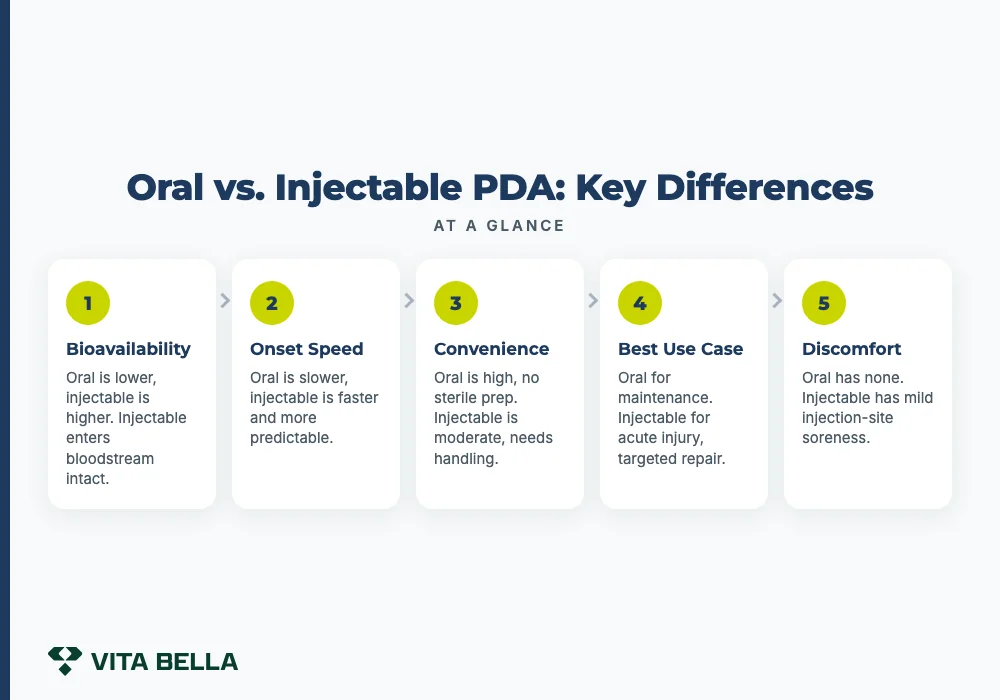
Both routes carry real advantages. Which fits best depends on your recovery goal.
| Factor | Oral | Injectable |
|---|---|---|
| Bioavailability | Lower; degraded by stomach enzymes | Higher; enters bloodstream intact |
| Onset speed | Slower systemic absorption | Faster, more predictable |
| Convenience | High; no sterile prep required | Moderate; sterile handling needed |
| Best use case | Maintenance, gut support | Acute injury, targeted tissue repair |
| Discomfort | None | Mild injection-site soreness |
Peptide delivery methods continue to improve. Lipid-based encapsulation now gives oral formulations better protection against enzymatic breakdown. That said, injectable precision remains the standard for acute recovery goals, as a 2024 review in the International Journal of Molecular Sciences notes. Both delivery formats are available through provider-guided programs at Vita Bella. How each performs depends on the biology involved.
Does pentadeca arginate work for recovery?
Yes. Preclinical evidence consistently shows that pentadecapeptides reduce inflammation and accelerate tissue repair. A 2016 study in Current Neuropharmacology found that BPC-157, the structurally related compound most studied in this class, improved fibroblast proliferation and collagen fiber alignment in animal tendon injury models, producing faster functional recovery. That work provides the biological foundation for PDA peptide recovery applications.
The repair mechanism centers on angiogenesis. A 2025 narrative review in Current Reviews in Musculoskeletal Medicine found that BPC-157 increases vascular endothelial growth factor receptor-2 (VEGFR2) activity and promotes nitric oxide signaling through the Akt-eNOS pathway, triggering new capillary formation in low-blood-flow musculoskeletal tissues. More blood supply accelerates repair. Inflammation decreases as circulation improves.
Direct human clinical trials on PDA specifically are not yet published. Current evidence draws from BPC-157 and structurally related pentadecapeptides that share PDA's core amino acid sequence.
Is oral pentadeca arginate as effective as injections?
Not equally. Injectable PDA consistently delivers higher tissue concentrations with more predictable results. Oral PDA is a different tool, better suited to maintenance than acute repair.
A 2016 review in the Saudi Pharmaceutical Journal identified enzymatic degradation and poor intestinal absorption as the primary barriers to oral peptide efficacy. Parenteral routes remain the benchmark for consistent systemic delivery. That gap has not been fully closed by current oral formulations.
One piece of evidence distinguishes oral pentadecapeptide administration from most conventional peptides. Research cited in Neural Regeneration Research (2022) found that oral BPC-157 remains stable in human gastric juice for more than 24 hours and requires no carrier molecule. If oral PDA shares that stability profile, sustained gut-tissue support may be its clearest application.
For pda oral vs injection decisions around acute musculoskeletal injuries, injections are the more reliable option. For ongoing maintenance when adherence and convenience matter, oral delivery can be appropriate.
What is the best way to take pentadeca arginate?
Choosing the right pda oral vs injection format starts with a provider review of your health history, injury severity, and recovery goals. Pentadeca arginate dosage varies across users based on those factors. Labs are recommended rather than required and help individualize the protocol further. No universal dose applies to every case.
For acute injuries, most providers prefer injectable peptides for injury because of the consistent bioavailability advantage. For maintenance or gut support, oral delivery reduces adherence burden over time. How providers structure and adjust peptide programs across multiple treatment windows explains the cycle design decisions that inform those choices.
How fast does pentadeca arginate work?
Injectable PDA begins working faster. The compound reaches circulation without passing through the GI tract, so onset can occur within hours. Oral PDA takes longer to accumulate effective tissue concentrations, depending on formulation quality and how much survives digestion.
Functional markers such as reduced stiffness, better range of motion, and lower post-activity soreness emerge at different rates based on injury type and baseline health. A 2025 paper in Arthroscopy noted early evidence that BPC-157 improves endurance, metabolism, and tissue repair in preclinical models; translating those timelines to human recovery requires individualized provider assessment. No published human pharmacokinetic data exist for PDA specifically.
What are the side effects of pentadeca arginate injections?
Mild discomfort, transient redness, and minor bruising at the injection site are the most common practical concerns. These effects reflect subcutaneous injection in general rather than peptide-specific toxicity. Proper sterile technique minimizes infection risk. A provider should guide your injection protocol.
The underlying safety data come from structurally related compounds. BPC-157 research compiled in Current Neuropharmacology (2016) reported a favorable safety profile with no serious adverse effects in preclinical models. Oral PDA carries no injection-site concerns but introduces more variable absorption. No long-term human safety data on PDA specifically are published. A licensed provider should confirm the protocol is appropriate before you begin.
BPC-157 vs PDA: what the evidence shows
When comparing bpc 157 vs pda, the key distinction is clinical maturity, not mechanism. BPC-157 has decades of preclinical evidence behind it. PDA is an arginine-modified form of the same core pentadecapeptide, developed to improve stability and tolerability, particularly in oral formulations.
Both compounds influence angiogenesis, collagen synthesis, and inflammatory signaling through overlapping pathways. Both have preclinical evidence in musculoskeletal repair contexts. PDA's arginine modification is thought to improve receptor binding, though that has not been confirmed in published human trials. Pentadeca arginate benefits currently rest on mechanistic plausibility and the BPC-157 evidence base. That is a reasonable scientific foundation, not a proven equivalence.
Understanding where peptides like PDA fit within broader recovery and hormone programs at Vita Bella helps clarify which protocol makes sense for your goals.
Ready to find your protocol?
Get Started to connect with a licensed provider who reviews your recovery goals and determines whether oral or injectable PDA fits your situation.
Frequently asked questions
Preclinical research on BPC-157, a structurally related compound, consistently shows accelerated tendon and tissue repair, reduced inflammation, and improved collagen alignment. PDA shares BPC-157's core peptide sequence and is thought to work through the same pathways. Human clinical trials specific to PDA are not yet published.
A licensed provider determines the best route based on your recovery goal, injury type, and health history. Injectable PDA is generally preferred for acute musculoskeletal injuries because of higher bioavailability. Oral formulations work well for maintenance and gut support when injection adherence is a concern.
Injectable PDA delivers higher, more consistent tissue concentrations than oral formulations, making it the preferred option for acute recovery goals. Oral PDA faces enzymatic breakdown in the GI tract, which reduces systemic bioavailability, though research on related compounds suggests retained localized activity. The best choice depends on your goals and provider recommendation.
BPC-157 research reports a favorable safety profile with no serious adverse effects in preclinical models, and PDA is structurally related. Injection-site effects such as mild discomfort or minor bruising are the most common practical concerns. Working with a licensed provider ensures proper sterile technique and a protocol suited to your health history.
Sources
- Vukojević J et al. (2022). Pentadecapeptide BPC 157 and the central nervous system. Neural Regeneration Research. PubMed
- Nicze M et al. (2024). The current and promising oral delivery methods for protein- and peptide-based drugs. International Journal of Molecular Sciences. PubMed
- Muheem A et al. (2016). A review on the strategies for oral delivery of proteins and peptides and their clinical perspectives. Saudi Pharmaceutical Journal. PubMed
- DeFoor MT & Dekker TJ (2025). Injectable therapeutic peptides: an adjunct to regenerative medicine and sports performance? Arthroscopy: The Journal of Arthroscopic & Related Surgery. PubMed
- Sikiric P et al. (2016). Brain-gut axis and pentadecapeptide BPC 157: theoretical and practical implications. Current Neuropharmacology. PubMed
- McGuire FP et al. (2025). Regeneration or risk? A narrative review of BPC-157 for musculoskeletal healing. Current Reviews in Musculoskeletal Medicine. PubMed