Anti aging peptides are short chains of amino acids that signal the body to rebuild collagen, improve skin elasticity, and support cellular repair. They do not stop aging's progression, but research shows they can meaningfully slow visible and functional decline. For a provider-led approach, explore Vita Bella's anti-aging programs.
What causes aging skin, and how do anti aging peptides address it?
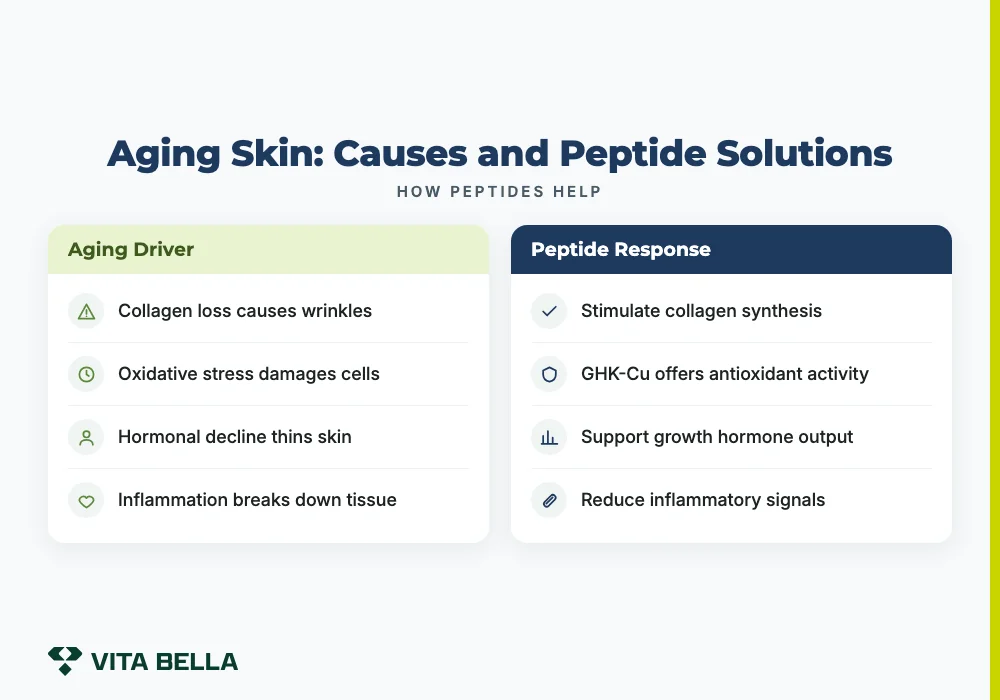
Skin ages for several overlapping reasons. Collagen production falls, oxidative stress accumulates, and the hormonal signals that govern tissue repair weaken over time. Aging skin supplements and peptide compounds work by sending molecular cues that prompt the body to rebuild what time has worn down.
A 2020 review by Li et al. in Food Science and Human Wellness found that dietary and supplementary peptides can support tissue maintenance in aging adults through collagen peptide benefits that reinforce skin structure.
| Aging driver | Effect on skin | How anti aging peptides respond |
|---|---|---|
| Collagen loss | Wrinkles, sagging | Stimulate fibroblast collagen synthesis |
| Oxidative stress | Cell damage, uneven tone | GHK-Cu copper peptide carries antioxidant activity |
| Hormonal decline | Thinning skin, poor repair | GH-releasing peptides support growth hormone output |
| Chronic inflammation | Accelerated tissue breakdown | Anti-inflammatory compounds reduce inflammatory signals |
How do peptides help slow skin aging?
Peptides slow skin aging by triggering collagen synthesis, reducing inflammation, and activating cellular repair pathways that weaken with age. This is the mechanism that makes peptide therapy for skin clinically relevant, not just a marketing claim.
Collagen peptide benefits start at the fibroblast. These cells manufacture new collagen and elastin; stimulating them is how most topical and injectable anti aging peptides improve skin structure from within. A 2023 paper by Santos et al. in the Journal of Cosmetic Dermatology confirmed that these compounds improve skin texture and hydration, particularly when delivered through formulations designed to increase skin absorption.
Short peptides act quickly. A 2021 analysis by Zhao et al. in the Journal of Functional Foods showed how collagen-derived peptides and their synthetic analogs reinforce skin at the molecular level. Structurally stable compounds like GHK-Cu work on a longer timeline, gradually reorganizing the extracellular matrix that gives skin its firmness and moisture retention.
What are the best peptides for anti-aging?
GHK-Cu copper peptide, CJC-1295, BPC-157, and Ipamorelin are the most evidence-reviewed compounds in anti-aging protocols. The right choice depends on your goals: skin repair calls for different compounds than hormone support or injury recovery.
GHK-Cu copper peptide
GHK-Cu promotes collagen and elastin production, reduces inflammation, and may influence biological aging through changes in DNA methylation. Research backs this up. A 2020 review by Ferreira et al. in Cosmetics ranked it among the leading anti-aging compounds with documented skin benefits. For the full evidence profile, see how GHK-Cu boosts skin elasticity and fights wrinkles.
CJC-1295
CJC-1295 is a growth hormone-releasing peptide that amplifies the body's natural GH pulses. Higher growth hormone levels support lean muscle, fat metabolism, and skin repair. The Vita Bella formulation uses CJC-1295 without DAC, which means it works with individual GH pulses rather than producing a sustained, flat hormone elevation across multiple days.
BPC-157
BPC-157 is a synthetic peptide studied for tissue healing and gut health. It reduces systemic inflammation and supports recovery from injury, both of which affect skin condition. Full compound details are available on the BPC-157 education page.
Ipamorelin
Often paired with CJC-1295, ipamorelin selectively stimulates GH release with a clean side-effect profile. It supports energy, sleep quality, and body composition. Consistent, restorative sleep shows directly in skin health over time.
What is the difference between topical and injectable peptides?
Topical anti aging peptides improve surface texture and hydration but stay at the skin level; injectable peptides reach systemic circulation and support deep tissue repair, hormone balance, and whole-body cellular maintenance. That is the essential distinction.
Topical peptides face a structural barrier. Most are too large to cross intact skin in meaningful quantities, so their benefits remain surface-level. Peptide injections wellness protocols bypass this entirely. Under provider supervision, injectable compounds can support skin elasticity treatment, growth hormone levels, and metabolic repair at the same time.
A 2026 clinical primer by Mayfield et al. in the American Journal of Sports Medicine notes that provider-guided protocols are essential for safe and effective injectable peptide use. For context on how topical approaches stack up, see tretinoin and its evidence base for aging skin.
Are anti aging peptides safe to use?
Most of these compounds are safe under medical supervision, with possible but uncommon side effects. That is the short answer.
Large-scale, long-term trials are still limited. Individual responses vary. A licensed provider determines the dose based on your health history and goals. Labs are recommended rather than required for peptide protocols; they help individualize the approach and give the provider a clearer clinical baseline.
Possible side effects may occur but tend to be mild and reversible under monitoring. Risk concentrates in unsupervised use without a clinical baseline, not in the compounds themselves.
How long does it take for peptides to show anti-aging results?
Topical peptides typically show visible improvements in skin hydration and fine-line texture within four to eight weeks of consistent use. Injectable anti aging peptides take longer. Most people notice meaningful changes in skin quality, energy, and body composition within eight to twelve weeks, with continued improvement building over six months.
Consistency matters more than speed. Peptide signaling is cumulative: each dose reinforces the repair pathways triggered by the last one. Stopping early cuts off that compounding effect, and early gains can diminish. Treat these compounds as long-term tools, not single-course treatments.
Start with a provider who knows your numbers
Vita Bella connects you with licensed providers across 47 states who build peptide protocols based on your goals and clinical picture. Whether your focus is skin, energy, recovery, or longevity, the process starts with understanding your baseline.
Frequently asked questions
GHK-Cu copper peptide, CJC-1295, BPC-157, and Ipamorelin are among the most studied compounds in anti-aging protocols. Each targets a different mechanism: collagen synthesis, growth hormone support, tissue repair, or selective GH release. A licensed provider matches the compound to your specific goals and health profile.
Peptides bind to receptors that trigger collagen and elastin production, reduce inflammation, and support cellular repair. Collagen peptide benefits accumulate with consistent use, gradually improving skin elasticity and hydration. The effect builds over months, not days.
They are generally well-tolerated under medical supervision. Possible side effects may occur but are typically mild and reversible when a licensed provider monitors the protocol. Long-term safety varies by compound, which is why ongoing oversight matters.
Topical peptides improve surface-level skin texture and hydration but have limited penetration into deeper tissue. Injectable peptides reach systemic circulation, supporting collagen production, hormone levels, and whole-body repair at a substantially deeper level.
Topical peptides often show visible improvements in four to eight weeks. Injectable protocols typically produce noticeable changes in skin quality and energy within eight to twelve weeks, with continued gains building over six months of consistent use.
Sources
- Li Y et al. (2020). Dietary peptides in aging: Evidence and prospects. Food Science and Human Wellness. Source
- Ferreira MS et al. (2020). Trending Anti-Aging Peptides. Cosmetics. Source
- Santos J et al. (2023). Anti-aging peptides for advanced skincare: Focus on nanodelivery systems. Journal of Cosmetic Dermatology. Source
- Zhao X et al. (2021). Collagen peptides and the related synthetic peptides: A review on improving skin health. Journal of Functional Foods. Source
- Mayfield CK et al. (2026). Injectable Peptide Therapy: A Primer for Orthopaedic and Sports Medicine Physicians. The American Journal of Sports Medicine. PubMed