
IGF-1 LR3 benefits include accelerated muscle protein synthesis, faster tissue repair, and reduced downtime between intense training sessions. The compound is an engineered analog of insulin-like growth factor-1, built to bind more readily to the IGF-1 receptor than the body's own version. Athletes and active adults exploring hormone therapy often ask about it as part of a structured recovery program. Research documents what the compound actually does, how LR3 differs from natural IGF-1, and what a provider weighs before recommending it.
What is the difference between IGF-1 and IGF-1 LR3?
IGF-1 LR3 differs from standard IGF-1 in one targeted engineering change: it has significantly reduced affinity for IGF-binding proteins. Most circulating IGF-1 in the body is bound to carrier proteins that restrict receptor access. LR3 sidesteps that restriction, leaving more active ligand available where it matters.
Peer-reviewed work published in the Journal of Biological Chemistry characterizes LR3's structure and confirms it functions as an active IGF-1 receptor ligand. Separate analytical research detected and quantified LR3 and its metabolites in human plasma, enabling rigorous pharmacological tracking.
The result is a stronger, more sustained signal through the same pathway natural IGF-1 uses. LR3 does not create a new mechanism. It amplifies an existing one.
What are the IGF-1 LR3 benefits?
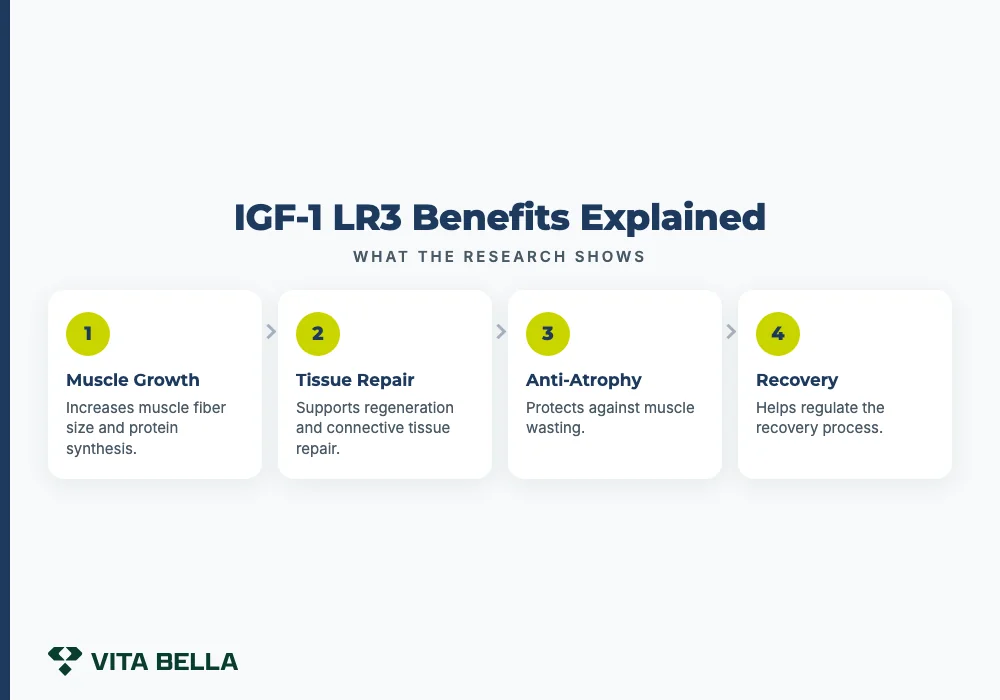
Across human and human-cell studies, IGF-1 LR3 benefits span muscle fiber growth, accelerated regeneration, connective tissue support, and anti-atrophy protection. The table below maps each benefit to its mechanism and the research that documents it.
| Benefit | Mechanism | Source |
|---|---|---|
| Muscle hypertrophy | Akt/mTOR activation drives protein synthesis | Frontiers in Nutrition, 2019 |
| Cellular muscle growth | Increased myotube nuclei, fusion index, contractile protein | Experimental Cell Research, 2004 |
| Tissue regeneration | Satellite cell activation, MMP coordination | Seminars in Cell & Developmental Biology, 2021 |
| Connective tissue repair | Collagen expression in tendon-derived cell models | International Journal of Molecular Sciences, 2023 |
| Anti-atrophy | Suppresses ubiquitin-proteasome pathway activity | Cells, 2020 |
| Recovery regulation | Cytokine crosstalk (IL-6) during repair | Cells, 2019 |
Is IGF-1 LR3 effective for building muscle?
Yes, based on available evidence. A 2004 study in Experimental Cell Research found that IGF-1 drove clear hypertrophy markers in human myotubes: more nuclei per fiber, a higher fusion index, and elevated myosin heavy chain content. These are the same cellular changes that underpin strength and size gains from resistance training.
The Akt/mTOR pathway is the central switch that translates exercise and nutrition into muscle protein accretion. A 2019 review in Frontiers in Nutrition connected resistance training, nutrient timing, and IGF-1 pathway responsiveness directly to mTOR-driven synthesis. LR3's reduced binding-protein affinity means more active ligand reaches that switch.
IGF-1 LR3 muscle growth requires a training stimulus. LR3 amplifies the signal; training generates it.
How does IGF-1 LR3 improve muscle recovery?
IGF-1 LR3 recovery improvement comes through two parallel processes: faster fiber regeneration and better connective tissue repair.
A 2021 review in Seminars in Cell & Developmental Biology detailed how IGF-1 coordinates immune-matrix interactions after intense effort. It activates satellite cells and directs matrix metalloproteinases to remodel the extracellular scaffold around repaired fibers. That coordination is why stronger IGF-1 receptor signaling shortens the gap between hard sessions.
Tendons recover more slowly than muscle. A 2023 review in the International Journal of Molecular Sciences found that IGF-1 stimulates collagen expression and matrix synthesis in human tendon-derived cell constructs. This connective tissue dimension is an underappreciated IGF-1 LR3 benefit for anyone managing chronic joint stress or an injury history.
A 2019 review in Cells also showed how IGF-1 interacts with IL-6 to regulate the broader repair cascade. Recovery is a coordinated sequence, and IGF-1 signals run through most of it.
How long does IGF-1 LR3 take to work?
Timelines for experiencing IGF-1 LR3 benefits vary based on individual baseline, training load, and protocol design. Most providers report that igf-1 lr3 recovery improvements, such as reduced soreness and a faster return to full capacity, become noticeable within the first several weeks of a structured course.
Measurable changes in lean mass take longer. They depend on training consistency, protein intake, and sleep quality. No clinical protocol replaces those fundamentals.
A licensed provider determines course length based on the individual's goals, baseline markers, and observed response. Labs are recommended rather than required; they help individualize what the provider recommends. For a detailed breakdown of course structure and what safety monitoring looks like, the IGF-1 LR3 dosage, cycle length, and safety results article covers those specifics.
How to boost IGF-1 naturally
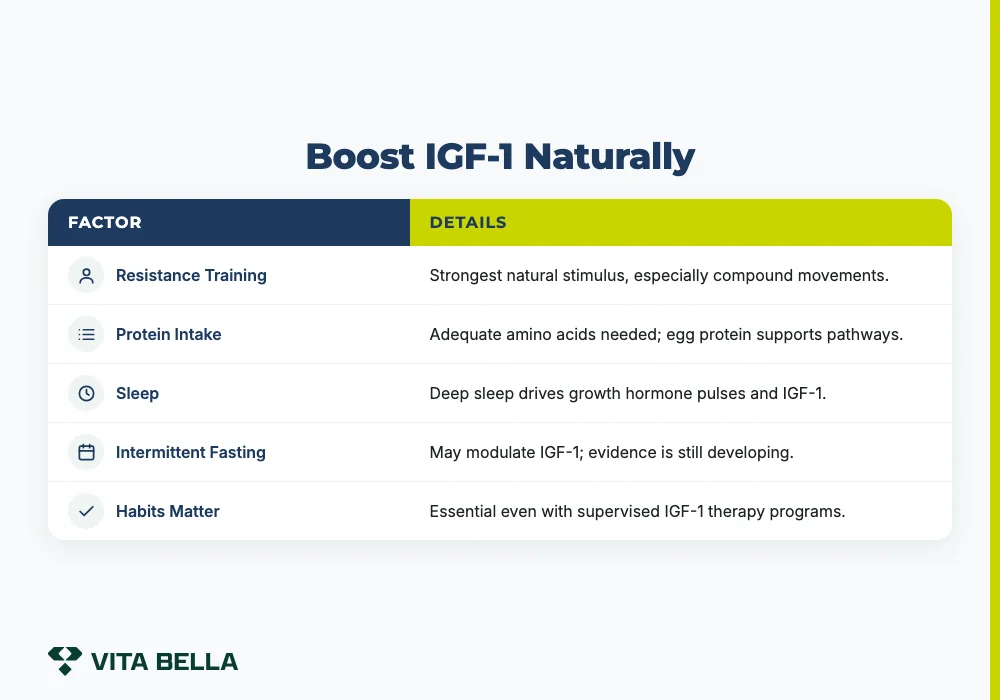
Several lifestyle factors reliably support natural IGF-1 levels before any clinical approach is considered.
Resistance training is the strongest natural stimulus. Compound movements drive the largest IGF-1 responses. Protein intake matters too; the body needs adequate amino acids to respond to IGF-1 signaling, and egg protein has been studied for its role in supporting anabolic pathways (Puglisi et al., Nutrients, 2022).
Sleep is non-negotiable. The largest natural growth hormone pulses, which drive hepatic IGF-1 production, occur during deep sleep. Intermittent fasting may also modulate IGF-1 and related metabolic signals, though the evidence is still developing (Reddy et al., Microbial Physiology, 2024).
These habits matter even within a supervised igf-1 therapy for athletes program. A well-designed protocol built on a poor foundation underperforms the same protocol on top of solid training and recovery habits.
IGF-1 LR3 dosage guide: how providers structure a course
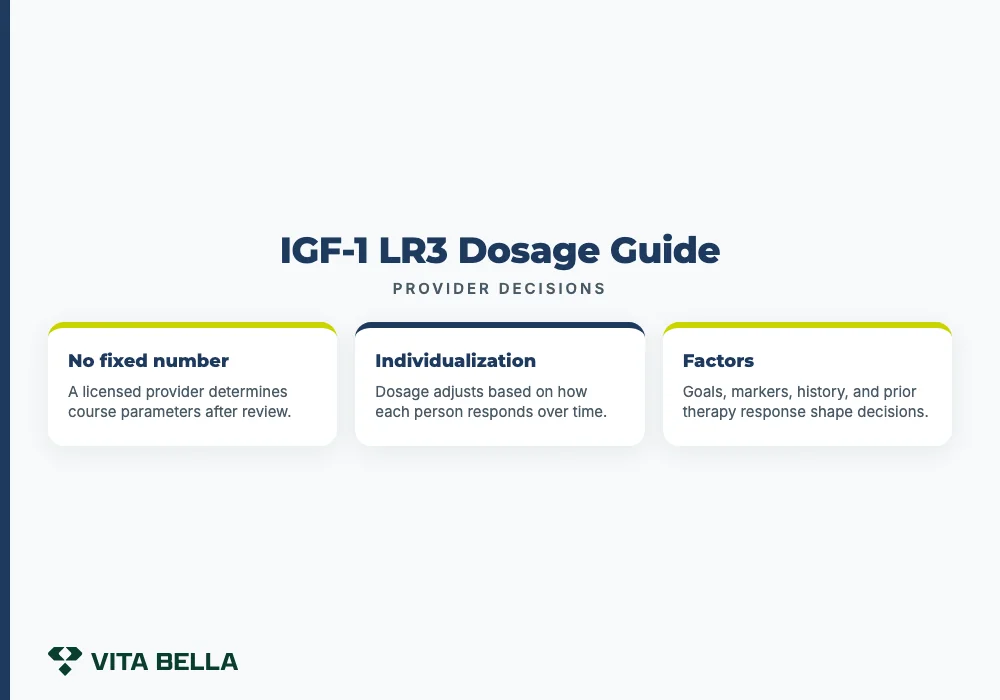
"IGF-1 LR3 dosage guide" often implies a fixed number. There is none. A licensed provider determines course parameters after reviewing individual goals, baseline hormone markers, and medical history.
Factors that shape the provider's decision include:
- Current IGF-1 baseline and any existing hormone imbalances
- Training history and current recovery capacity
- Body composition goals
- Prior response to peptide or hormone-based therapy
Individualization is the point. Standard reference ranges offer a starting framework, but a provider adjusts based on how each person responds over time. For context on how multi-compound programs are typically structured, including when to pause and restart a course, the safe peptide cycling protocols resource covers what provider-designed programs actually involve.
Do IGF-1 supplements work?
This question tends to conflate two different categories. Injectable IGF-1 LR3 has documented receptor activity in human cell models and measurable pharmacokinetics in human plasma. Oral products marketed as the best igf-1 supplement have no comparable evidence base. They are not the same compound delivered differently. They represent a fundamentally different category of product.
The most effective approach is a properly supervised protocol where a licensed provider monitors individual response and adjusts course parameters as needed. That is what clinical igf-1 therapy for athletes looks like in practice, and it is the framework that connects research evidence to real-world outcomes.
Talk to a provider about your options
This article is informational: IGF-1 LR3 is not part of Vita Bella's product offering, and the FDA continues to review medication options in this category. For provider-supervised hormone and performance support, Get Started to connect with a licensed provider today.
Frequently asked questions
IGF-1 LR3 benefits documented in human-cell research include enhanced muscle protein synthesis through Akt/mTOR activation, accelerated tissue regeneration via satellite cell recruitment, and improved connective tissue repair through collagen stimulation. Research also shows it suppresses pathways linked to muscle loss. All effects run through the IGF-1 receptor, with greater availability due to reduced binding-protein affinity.
IGF-1 LR3 improves recovery by activating satellite cells, coordinating matrix metalloproteinases during fiber repair, and stimulating collagen synthesis in tendon-derived cell models. It also regulates cytokine signaling, including IL-6, that governs the broader repair cascade. These mechanisms together reduce the time needed between high-intensity training sessions.
Human myotube studies show IGF-1 drives hypertrophy markers including increased nuclei per fiber, a higher fusion index, and elevated myosin heavy chain content. Combined with its Akt/mTOR-mediated protein synthesis pathway, this supports igf-1 lr3 muscle growth in human-relevant cell models. Clinical outcomes depend on training quality, protein intake, and overall protocol design.
Recovery improvements such as reduced soreness and faster return to training capacity often appear within the first few weeks of a structured course. Changes in muscle composition take longer and depend heavily on training consistency and nutrition. A licensed provider sets course length based on individual baseline and response.
Natural IGF-1 binds strongly to carrier proteins in the bloodstream, limiting how much reaches the receptor. IGF-1 LR3 is engineered to have much lower binding-protein affinity, increasing receptor availability. Both act through the same IGF-1 receptor; LR3 delivers a stronger, more sustained signal.
Sources
- Barclay et al. (2019). The role of the IGF-1 signaling cascade in muscle protein synthesis and anabolic resistance in aging skeletal muscle. Frontiers in Nutrition. PubMed
- Yang et al. (2005). Probing the folding pathways of long R3 insulin-like growth factor-I via capture and identification of disulfide intermediates. Journal of Biological Chemistry. PubMed52934-9/fulltext)
- Yoshida & Delafontaine (2020). Mechanisms of IGF-1-mediated regulation of skeletal muscle hypertrophy and atrophy. Cells. PubMed
- Jacquemin et al. (2004). IGF-1 induces human myotube hypertrophy by increasing cell recruitment. Experimental Cell Research. PubMed
- Kok & Barton (2021). Actions and interactions of IGF-I and MMPs during muscle regeneration. Seminars in Cell & Developmental Biology. PubMed
- Thomas et al. (2010). Determination of LongR3-IGF-I, R3-IGF-I, Des1-3 IGF-I and their metabolites in human plasma by LC-MS. Journal of Chromatography B. PubMed
- Voorhamme & Yandell (2006). LONG R3IGF-I as a more potent alternative to insulin in serum-free culture of HEK293 cells. Molecular Biotechnology. PubMed
- Miescher et al. (2023). In vitro and in vivo effects of IGF-1 delivery strategies on tendon healing: A review. International Journal of Molecular Sciences. PubMed
- Forcina et al. (2019). Signals from the niche: Insights into the role of IGF-1 and IL-6 in modulating skeletal muscle fibrosis. Cells. PubMed
- Puglisi & Fernandez (2022). The Health Benefits of Egg Protein. Nutrients. PubMed
- Reddy et al. (2024). Health Benefits of Intermittent Fasting. Microbial Physiology. PubMed