TRT fertility preservation is achievable with the right protocol. Testosterone replacement therapy suppresses the hormonal signals that drive sperm production, and in many men that leads to severely reduced sperm count or complete azoospermia. The fix is not stopping treatment. Adding low-dose hCG with TRT maintains testicular function in most men and keeps male fertility hormone therapy compatible with family planning.
Does TRT make you infertile?
TRT does not permanently cause infertility in most men, but it does suppress sperm production significantly while you are on it. When exogenous testosterone enters the body, the hypothalamus and pituitary detect high circulating levels and cut output of LH and FSH.
Without those signals, testosterone replacement sperm production inside the testes drops sharply. Clinical reviews show TRT can lead to azoospermia or severe oligospermia in many men who use it without concurrent fertility support. Recovery is possible after stopping TRT, but the timeline ranges from months to over a year.
How TRT affects testosterone and sperm count
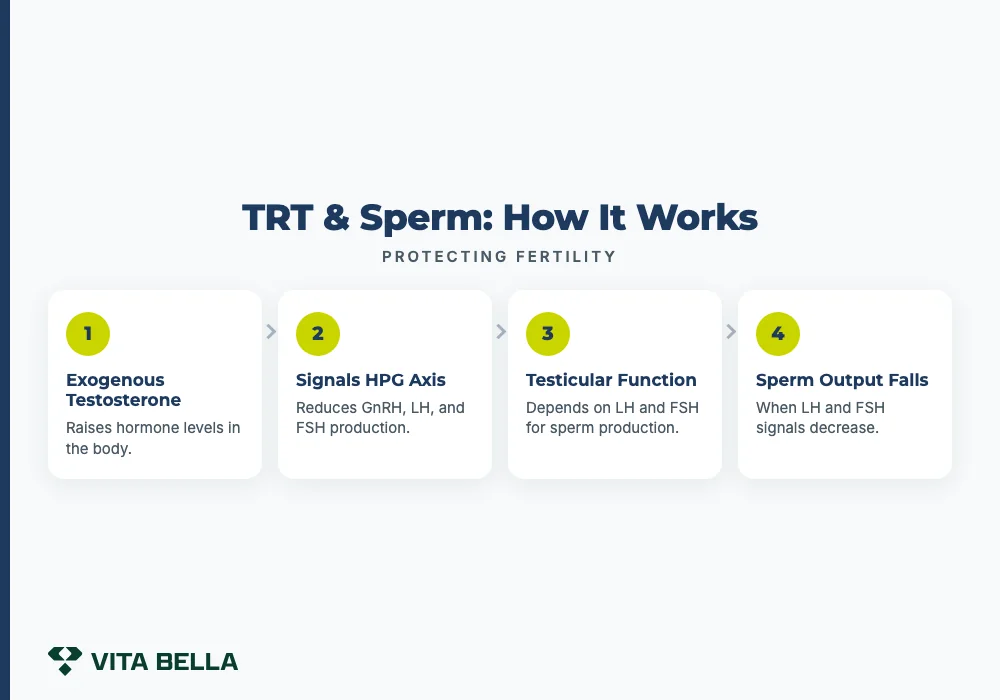
The mechanism is direct. Exogenous testosterone raises circulating hormone levels, signaling the hypothalamic-pituitary-gonadal (HPG) axis to reduce GnRH, LH, and FSH production. Testicular function depends on LH to produce intratesticular testosterone and on FSH to drive sperm maturation. When both signals fall, sperm output follows.
| Risk factor | Effect on sperm recovery |
|---|---|
| Age under 35 | Faster, more complete recovery typical |
| Age 35 or older | Slower recovery; higher suppression risk |
| TRT duration under 12 months | Better recovery odds |
| TRT duration over 12 months | Deeper HPG suppression; longer rebound |
| Prior low sperm count | High risk of incomplete recovery |
| Anabolic steroid history | Highest suppression risk; intensive reboot often needed |
A 2022 study in Fertility and Sterility found that even with intensive hCG plus FSH reboot therapy, fewer than half of men previously on testosterone regained full semen parameters. That result makes the case for starting protection early, not reactively.
Does hCG preserve fertility on testosterone therapy?
Yes. Low-dose hCG with TRT is the most established approach for trt fertility preservation. hCG mimics LH and stimulates the testes to maintain intratesticular testosterone, the critical driver of spermatogenesis. In men receiving TRT plus hCG, testicular size and sperm output are better preserved than in men using testosterone alone, according to research published in The Journal of Urology. A 2019 study in BJU International confirmed that low-dose hCG prevents azoospermia and maintains fertility in hypogonadal men on testosterone replacement.
For men exploring hCG for fertility, co-administration with TRT is the standard clinical approach, spermatogenesis continues while testosterone levels stay managed.
TRT fertility preservation: who needs protection before starting?
Anyone planning to father children in the near term should discuss preservation strategies before the first injection. Some groups carry particularly high risk:
- Men 35 and older. A 2024 review in World Journal of Men's Health notes that HPG shutdown is more pronounced with age-related hypogonadism, and recovery of spermatogenesis is slower and less complete. Fertility-protecting add-ons should be part of the conversation before therapy begins.
- Men planning long-term therapy. Duration of TRT correlates directly with the depth of HPG suppression. Longer courses generally produce slower, harder recoveries. Sperm banking before starting is a prudent step.
- Men with a history of low sperm count. Starting TRT with oligospermia or borderline semen parameters raises the likelihood of incomplete recovery. Baseline semen testing and early hCG co-administration are the standard protective approach.
- Men with anabolic steroid history. Prior anabolic-androgenic steroid use creates the highest risk for severe suppression. A 2022 study in Fertility and Sterility found that this group typically needs more intensive gonadotropin-based protocols, and recovery rates vary considerably.
For men who want to raise testosterone while keeping the HPG axis intact, alternatives like enclomiphene work differently: they stimulate natural LH and FSH rather than introducing exogenous hormone. Understanding Enclomiphene: Mechanism, Dosage, and What to Expect covers how that approach compares.
How long does fertility return after stopping TRT?
Most men recover sperm production after stopping TRT. Recovery commonly takes 6 to 24 months, and full restoration cannot be assured, as research in World Journal of Men's Health confirms. Age and treatment duration are the strongest predictors.
Younger men on shorter courses typically recover faster. Men over 40 on multi-year therapy may not fully recover even after a year off. Medical reboot protocols combining hCG with purified FSH can accelerate the process. Research in Fertility and Sterility found that up to 64.9% of men undergoing combined hCG-plus-FSH rescue therapy responded favorably after TRT-induced suppression. Response rates vary, and some men do not recover fully even with intensive treatment.
Can you get someone pregnant while on TRT?
Possibly, but the odds are substantially reduced. Testosterone and sperm count move in opposite directions on TRT: as exogenous testosterone rises, sperm output typically falls. Some men retain residual sperm production, but counts are often below the threshold for reliable natural conception.
The practical minimum for any man who wants to preserve sperm on testosterone: hCG co-administration and regular semen analysis. A reproductive urologist can assess individual sperm parameters and determine what additional support is appropriate.
Monitoring during male fertility hormone therapy
TRT is safe under qualified medical supervision. A standard monitoring schedule protects both hormonal balance and reproductive function:
- Test testosterone, LH, and FSH at baseline and every 3 to 6 months.
- Run semen analysis to track sperm count and motility.
- Check hematocrit, which can rise on testosterone therapy.
- Track testicular volume when hCG co-administration is part of the protocol.
Lifestyle adjustments support sperm health alongside medication. Avoiding heat exposure, quitting smoking, and optimizing sleep and diet all contribute meaningfully.
Standard lab panels sometimes read "normal" even when hormonal function is suboptimal. Understanding where your labs fall on the optimal versus normal spectrum can shape how your protocol is adjusted. The relationship between free and total hormone levels matters here too: how SHBG levels interact with your total testosterone reading explains why two men with identical total T numbers can feel completely different.
Start your TRT fertility preservation plan
Vita Bella's testosterone therapy protocols build fertility protection in from day one. Physician-led programs at Vita Bella pair testosterone therapy with hCG co-administration and regular semen monitoring, keeping hormone balance and reproductive health aligned.
Get Started with a provider-guided assessment and find out which protocol fits your goals.
Transform Your Life. You Owe It To Yourself. Get Started
Frequently asked questions
For most men, the suppression can improve after stopping TRT, though recovery can take 6 to 24 months. Full return to baseline is not assured, particularly in older men or those on long-term, high-dose therapy. Proactive sperm banking before starting TRT removes that uncertainty.
Yes. Low-dose hCG with TRT helps maintain intratesticular testosterone, which keeps spermatogenesis active during therapy. If suppression has already occurred, a combined hCG and FSH protocol can rescue sperm production in a meaningful proportion of men, though individual response rates vary.
Sperm banking before TRT is the most reliable option for any man who wants biological children in the future. It removes the risk of a months-long recovery attempt that may not fully succeed. Your provider can refer you to a reproductive urologist before your first injection.
Men over 35, those with a history of low sperm count, men planning long-term or high-dose therapy, and anyone with prior anabolic steroid use face the highest suppression risk. These groups should pursue baseline semen analysis and discuss hCG co-administration or sperm banking before starting testosterone replacement.
Sources
- Naelitz, B. D. (2022). Testosterone replacement therapy and spermatogenesis in reproductive age men. Translational Andrology and Urology. PubMed
- Stocks, B. et al. (2022). Optimal restoration of spermatogenesis following testosterone therapy using hCG and FSH. Fertility and Sterility. PubMed
- Kohn, T. P. et al. (2019). Concomitant intramuscular human chorionic gonadotropin preserves spermatogenesis in men undergoing testosterone replacement therapy. The Journal of Urology. PubMed
- Stocks, B. T. et al. (2022). Optimal restoration of spermatogenesis following testosterone therapy using hCG and FSH. Fertility and Sterility. PubMed
- Fink, J. (2024). Management of male fertility in hypogonadal patients on testosterone replacement therapy. World Journal of Men's Health. PubMed
- Ledesma, B. R. & Lipshultz, L. I. (2022). Fertility outcomes in men with prior history of anabolic steroid use. Fertility and Sterility. PubMed01882-4/fulltext)
- Avila, D. et al. (2019). Low-dose human chorionic gonadotropin prevents azoospermia and maintains fertility in hypogonadal men on testosterone replacement therapy. BJU International. PubMed01624-9/fulltext)
- Stahl, P. J. (2022). Recovery of spermatogenesis after hormone therapy: What to expect and when to expect it. World Journal of Men's Health. PubMed